Vampire Hunter D Recompilation
RecompilationActive
The original game's compiled code translated into a native program for a new platform, usually a PC port.
Based on Vampire Hunter D
 Links, repository & details
About
A static recompilation of Vampire Hunter D built on psxrecomp and recomp-ui, described as a native recompilation setup host. The README says release 0.3.0 supports Windows x64, while Linux and macOS release jobs are deferred.
Getting started
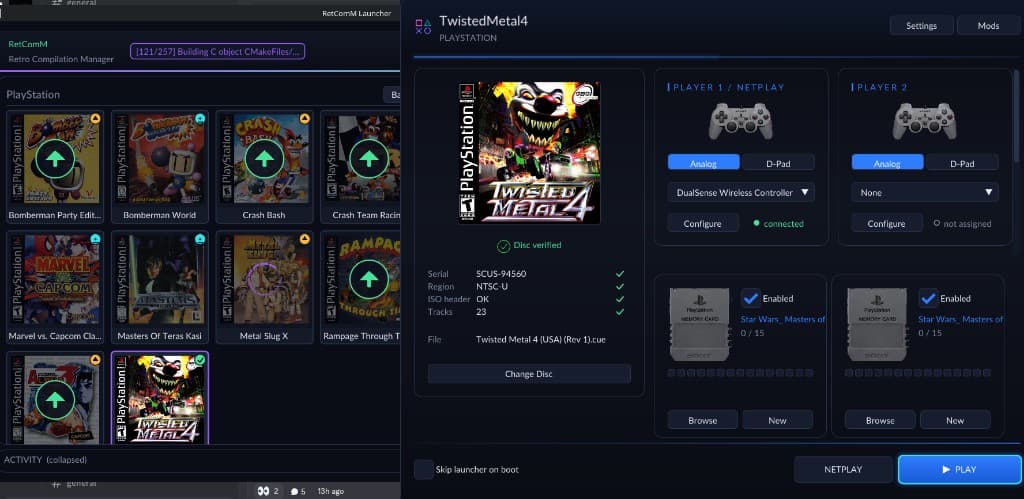
You must own the original game and provide your own supported disc image; retail BIOS files are not redistributed. The Windows setup host collects the required local inputs and builds the game on the user's computer. It can also be managed through the RetComM Launcher.
Known issues & limitations
- Linux and macOS releases are deferred; they remain in the workflow.
- Public v0.3.0 can request the wrong executable after the first local build.
- The exact-ZIP automatic relaunch remains a release gate.
What you need to run it
How to install
- Run it standalone using the release zip and the built-in Generate & Build flow.
- You can use RetComM Launcher to manage installs, updates, ROM/BIOS wiring, and queued builds.
Summarised from the project's README.
Media
Status & roadmap
- The README says the v0.3.3 source fixes a wrong executable name requested after the first local build in v0.3.0, and automatic relaunch from the exact ZIP remains a release gate.
FAQ
- What is Vampire Hunter D Recompilation?
- Vampire Hunter D Recompilation is an open-source recompilation of Vampire Hunter D. The original game's compiled code translated into a native program for a new platform, usually a PC port.
- Do I need the original game files to run Vampire Hunter D Recompilation?
- Yes. The project does not include the original game's assets, so you need your own copy.
- How is Vampire Hunter D Recompilation licensed?
- project: GPL-3.0-only (portfolio-owned source, scripts, configuration, and documentation); PSXRecomp: PolyForm Noncommercial 1.0.0 (PSXRecomp); Recomp-UI: MIT (Recomp-UI). The repository itself is the authoritative source.